
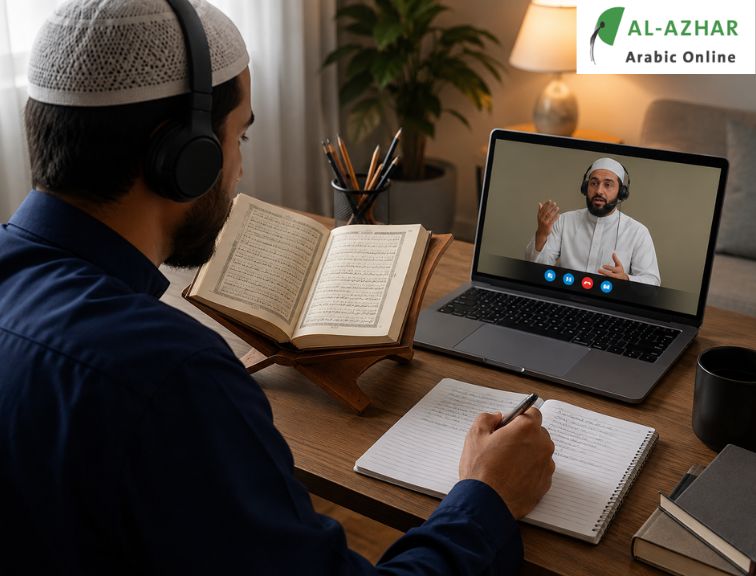
There is a familiar guilt that many Muslims carry quietly. The Quran sits on the shelf. Life keeps moving. The intention to learn, to improve, to pass the knowledge on to the children, never disappears. It just keeps getting postponed.
The problem is rarely commitment. It is logistics.
Traditional Quran classes ask you to show up at a fixed location at a fixed time, week after week. For a working parent in Birmingham, a university student in Toronto, or a professional in Sydney, that model simply does not survive contact with a real daily schedule.
This is precisely the gap that online Quran classes were built to fill. Not as a compromise, but as a genuine solution.
The Real Barrier to Quran Learning
Ask most adults why they have not pursued Quran learning or Arabic study consistently, and the answer comes back the same way every time. Not a lack of faith. Not a lack of desire. Time.
A full-time job takes eight to ten hours. Children take the rest. Commutes, meals, prayers, and sleep fill whatever remains. Fitting a fixed weekly class into that schedule requires either sacrifice or luck, and most people cannot manage either indefinitely.
What changes when Quran learning moves online is not the learning itself. The Tajweed rules are the same. The Arabic letters require the same attention. The teacher-student relationship matters just as much. What changes is the container around the learning: when it happens, where it happens, and for how long.
Did You Know? Al Azhar Arabic Online offers 24/7 flexible scheduling, meaning students across the USA, UK, Australia, and the Arab world can book sessions at times that fit their actual lives, not the other way around. Teachers are available across time zones so that a session after Fajr, during a lunch break, or after the children are asleep at night is entirely possible.
What Flexible Scheduling Actually Looks Like
Flexibility is a word that gets used loosely. In practice, it means specific things for specific people.
For a full-time professional, it means being able to book a 45-minute session at 7am before the workday starts, or at 9pm after the family is settled. For a stay-at-home parent, it means fitting a session during the school run window, when the house is quiet for an hour. For a student in a different country from their teachers, it means not being locked out of learning by a time zone difference.
At Al Azhar Arabic Online, the scheduling system is built around the learner’s availability rather than a fixed timetable. Students do not inherit a slot. They choose one. And when life changes, which it does, the schedule can change with it.
This matters more than it might seem. The single biggest predictor of whether someone continues their Quran learning is not how motivated they are at the start. It is whether the classes fit consistently enough into their life to become a habit. Flexibility is what makes consistency possible.
Expert Insight: Based on working with students across multiple continents over many years, the learners who progress most reliably are not necessarily the ones with the most time. They are the ones whose sessions fit naturally into their existing routine. A 30-minute session three times a week, booked around a commute or a lunch break, produces far more consistent progress than an hour-long class that requires reshuffling the entire week to attend.
Learning Across Time Zones
One of the most underappreciated benefits of an online platform is its relationship with geography.
A Muslim family that has moved from Egypt to Australia does not need to sacrifice Quranic education for their children because good local teachers are hard to find. A revert in Canada who wants to study Quranic Arabic with a teacher trained at Al-Azhar University in Egypt no longer needs to be in the same city, or the same continent, as that teacher.
Al Azhar Arabic Online’s teachers are Al-Azhar University graduates. That is not a general claim about quality: it refers specifically to graduates of Al-Azhar in Cairo, one of the oldest and most respected institutions of Islamic learning in the world. Instruction delivered by these teachers, via Skype from wherever the student happens to be, carries authentic scholarly lineage that local alternatives often cannot match.
For diaspora families in the UK, USA, Canada, and Australia, this is a meaningful difference. The teacher who instructs their child in Tajweed holds the same credentials as they would have received had the family remained in an Arabic-speaking country.
One-on-One Sessions: Why They Work for Busy People
Group classes are built around a pace that suits the average student. For a busy adult, average is a problem in two directions.
If the class moves too slowly, the time feels wasted. If it moves too quickly, the student falls behind and stops attending. Either way, the inconsistency of a busy schedule means that missing one group session can leave someone genuinely lost.
One-on-one sessions eliminate this entirely. The pace is yours. If work was difficult this week and you need to slow down on Tajweed, you slow down. If the children are on school holiday and you have more time and focus, the session can move faster. The teacher adjusts to you, not to the median of a group that is not there.
For a parent trying to learn alongside their child, or an adult who feels self-conscious about their level in a group setting, the private session removes a real barrier. Progress happens faster when no one is watching except the teacher, and the teacher’s entire focus is on you.
All Al Azhar Arabic Online courses are conducted as one-on-one sessions. This is not a premium tier. It is how every student learns from the start.
Common Mistakes: Many busy learners overestimate how much time they need to make meaningful progress. They postpone starting until they have a proper block of free time, which rarely arrives. A consistent 30-minute session three times a week will produce more progress than a single two-hour session once a fortnight. Starting with a realistic commitment is always better than waiting for an ideal one.
Short Sessions, Real Progress
The assumption that Quran learning requires long, uninterrupted study blocks belongs to the traditional madrasa model. That model works for full-time students in a residential setting. It does not translate to a professional’s Tuesday evening.
Effective Quran learning online can happen in sessions as short as 30 minutes when those sessions are focused, regular, and built on a structured curriculum. The key word is structured.
A session that reviews the previous week’s Tajweed rules, introduces a new letter or rule, applies it in recitation, and sets a short revision task for before the next session delivers concentrated, cumulative learning. Over weeks and months, this compounds. A student who shows up for 30 focused minutes three times a week will, after a year, have covered more ground than one who attends an hour-long weekly session irregularly.
Al Azhar Arabic Online courses cover the full range of Quran study: basic recitation for beginners, Tajweed rules for those who want to recite correctly, Hifz (memorization) for students committed to preserving the Quran, Quranic Arabic for those who want to understand what they are reading, and Islamic studies for those pursuing broader religious knowledge. Each of these can be structured into session lengths that a busy person can actually keep.
Pro Tip: When you first enroll, be honest about your availability rather than optimistic. Book the session frequency you can reliably keep, not the frequency you aspire to. A teacher who knows you have 30 minutes three times a week will build a curriculum around that. A curriculum built around four sessions a week that you can only attend twice will leave you feeling behind every single week.
Quran Learning for Kids in a Busy Household
For parents, the challenge is doubled. They want their children to learn Quran but cannot always ferry them to classes, and their own learning comes second.
Online Quran classes solve the logistics of children’s education at the same time. A child who learns via a one-on-one session at home, with a teacher who uses age-appropriate methods and visual aids, does not need to travel anywhere. The parent does not need to coordinate school runs with class schedules. The session happens at home, at a time the family chooses.
Al Azhar Arabic Online’s Quran classes for kids are specifically designed for young learners, with teachers trained in engaging children and parents guided on how to support revision between sessions. Testimonials from families describe children at five and six years old able to recite correctly after consistent attendance, with parents noting the improvement in pronunciation specifically.
For households where both parents work and the family is already managing multiple schedules, the ability to fit a child’s Quran session into a window that already exists in the week, rather than creating a new logistical obligation, matters enormously.
Keeping Consistency Without Burnout
Consistency is the goal. Burnout is what happens when consistency is pursued without enough self-awareness.
A student who commits to daily sessions because they feel guilty about years of delay is setting themselves up to drop out within a month. A student who commits to three sessions a week at realistic times, with the understanding that some weeks will be harder than others, is setting themselves up to still be learning a year from now.
The teacher relationship matters here too. A good Quran teacher is not simply a transmitter of rules. They are a guide who notices when a student is struggling, adjusts the pace accordingly, and provides the kind of encouragement that keeps a busy person coming back to something that competes with every other demand on their time.
Al Azhar Arabic Online teachers are selected not only for their credentials but for their experience in teaching non-Arabic speakers and learners from diverse backgrounds. For a revert who has never encountered Arabic script, or an adult returning to Quran study after many years away, the teacher’s ability to meet the student where they are, rather than where a syllabus expects them to be, makes the difference between progress and abandonment.
What Al Azhar Arabic Online Offers Busy Learners
To summarise what the platform provides for someone whose schedule is genuinely full:
- 24/7 flexible session booking: Sessions available in the morning, afternoon, evening, and night, across all major time zones including the USA, UK, Canada, and Australia. No fixed timetables. No commuting.
- One-on-one instruction throughout: Every student, from the first session, has a teacher’s complete attention. The pace, the focus, and the curriculum are all adjusted to the individual learner.
- Al-Azhar-certified teachers: Instructors are graduates of Al-Azhar University, with Ijaazah in Quran recitation where applicable. Instruction delivered via Skype in a live, interactive format.
- Courses for all levels and ages: From a complete beginner who cannot yet read Arabic script, to an advanced learner working toward Hifz, to a child taking their first steps. Islamic studies and Quranic Arabic are also available for students who want to understand the language of what they are reciting.
- Flexible session lengths: Sessions can be tailored to fit the time available, whether that is 30 minutes three times a week or a longer session once or twice a week.
The path to the Quran has always been worth taking. The question for most busy Muslims is not whether they want to take it. It is whether the conditions are right for them to start and keep going. Online Quran classes, done well, answer that question.
Register with Al Azhar Arabic Online today and start with a trial session that fits around your schedule.
