Most people searching for an online Quran teacher are not short on options. A thirty-second search returns dozens of platforms, hundreds of profiles, and a wide range of prices and promises.
What most people are short on is a framework for choosing well.
This is not a minor decision. The pronunciation habits you build early, and the understanding you develop over time, will follow you for the rest of your life. A good teacher builds that foundation correctly. A poor choice costs months of correcting what was learned wrong.
Here is what to actually look for.
Credentials First: What Ijazah and Al-Azhar Qualification Mean
The best online Quran teacher holds an Ijazah, an authorization from a qualified scholar confirming they have mastered Quranic recitation and are certified to teach it. This is not a certificate from a short course. It is a chain of verified transmission linking teacher to teacher, stretching back across centuries to the Prophet Muhammad, peace be upon him, himself.
An Ijazah cannot be self-awarded. It requires reciting the complete Quran to a qualified scholar who holds their own Ijazah, and receiving confirmation that the recitation meets the required standard.
A degree from a recognised Islamic university such as Al-Azhar University in Cairo or the Islamic University of Madinah carries additional weight as a formal scholarly qualification. Al-Azhar, founded in 970 CE, is one of the oldest universities in the world and among the highest authorities on Islamic scholarship globally. A teacher educated there has studied Quran, Tajweed, Arabic, and Islamic sciences within a rigorous scholarly tradition.
Did You Know? Al Azhar Arabic Online’s teachers are graduates of Al-Azhar University in Cairo and hold Ijazah in Quran recitation and teaching. This is not a general claim of quality. It is a specific, verifiable credential from one of the oldest and most respected Islamic institutions in history.
When a teacher cannot clearly state their qualifications, that is itself information. Genuine credentials do not need to be hidden.
Teaching Experience Is Not the Same as Knowledge
Knowing the Quran and being able to teach it are two distinct skills. A scholar who has memorised the complete Quran and mastered Tajweed may still be an ineffective teacher for a non-Arabic-speaking adult in the UK, or for a seven-year-old learning their first letters, if they have not developed the pedagogical skills to reach different kinds of learners.
Pedagogical skill and clear communication matter as much as formal credentials. A qualified Quran teacher should be able to adapt their approach to the student’s level, pace, and learning goals.
When evaluating a teacher’s experience, ask specific questions rather than accepting general answers.
- Have they taught students at your level before, complete beginners, intermediate readers, Hifz students?
- Have they worked with students from your background, non-Arabic speakers, children, adults returning to Quran study after a gap?
- What does a typical lesson structure look like?
- How do they approach correcting pronunciation errors without discouraging the student?
The answers reveal whether the experience claimed is genuinely relevant to your situation.
The Trial Lesson: Your Most Important Research Tool
Every serious Quran teacher or platform should offer a trial lesson. Not as a promotional courtesy, but as your single most valuable evaluation tool.
Notice whether you feel comfortable and understood, and whether the teacher explains things clearly at your level.
During the trial, pay attention to:
- Pronunciation correction: Does the teacher notice and address your errors? Do they explain how to correct them clearly, or simply repeat the correct sound without explanation?
- Pacing: Does the lesson move at a pace that allows genuine absorption, or does it rush through material to seem productive?
- Communication: Can the teacher explain Tajweed rules and Quranic concepts in your preferred language, with clarity rather than jargon?
- Patience: Learning the Quran takes time. A teacher who becomes visibly impatient or rushes a beginner during a trial lesson will not become more patient over time.
Expert Insight: The most revealing question in a trial lesson is to ask the teacher to explain why a specific letter is pronounced the way it is, not just how. A teacher who understands the Makharij (articulation points) at a scholarly level answers immediately. A teacher who learned by rote cannot. That distinction matters every time a pronunciation error needs correcting at the root.
Flexible Scheduling That Matches Your Reality
An online Quran teacher’s availability needs to fit around your actual life.
For working adults in the UK, USA, Canada, or Australia, this means genuine availability across time zone differences. For families with children, it means sessions that fit around school hours without restructuring the entire day.
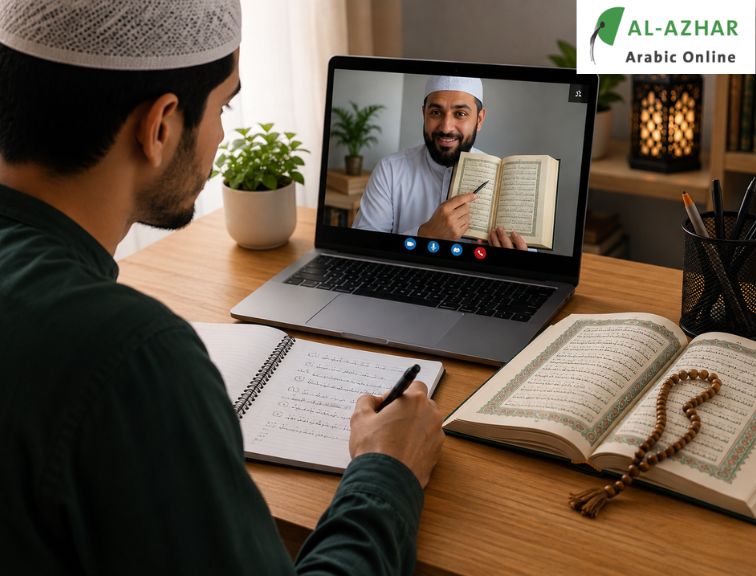
Al Azhar Arabic Online offers 24/7 scheduling across all major time zones. All sessions are one-on-one via Skype. No group to keep pace with. No curriculum built around someone else’s level.
Pro Tip: Test a teacher’s responsiveness before committing. A teacher who is difficult to reach for scheduling questions before enrolment will not become easier to reach after it. The first two weeks reflect the long-term pattern.
What the Best Online Quran Teachers Have in Common
Whether you are an adult beginner working toward reading Al-Fatiha correctly in your Salah, a parent enrolling a child in their first Quran classes, or a more advanced student working toward Hifz, the criteria for a quality teacher hold across all of those situations.
The best online Quran teacher is:
- Formally qualified, holding an Ijazah and ideally a degree from a recognised Islamic institution
- Experienced with your specific context, not just with Quran students in general
- Transparent about credentials, willing to verify them clearly
- Adaptable, meeting you at your level rather than delivering a fixed script
- Available on your schedule, across your time zone and around your commitments
- Patient, building confidence alongside knowledge
Al Azhar Arabic Online connects students worldwide with teachers who meet every one of these standards: Al-Azhar University graduates with Ijazah, teaching one-on-one via Skype, available 24/7.
Register today and take your first session. The right teacher makes a difference from lesson one.
